You have probably heard that recruiters spend “six seconds” on a resume. It is one of the most repeated facts in job hunting, and like most repeated facts it is half true. Here is what the research really shows about how resumes are read, where the numbers come from, and what it means for yours.
Where the “six seconds” comes from
The number comes from two eye-tracking studies by Ladders, a US job site.
- In 2012, Ladders tracked the eyes of 30 professional recruiters over 10 weeks as they reviewed resumes. They spent about 6 seconds on the first fit or no-fit decision. Asked how long they spent, the same recruiters guessed about four minutes.
- In 2018, an update measured an average first screen of 7.4 seconds and looked at which layouts worked best.
Two things to keep in mind. These are company studies, not peer-reviewed research, and the 2018 one never said how many recruiters took part, a gap pointed out in a critique on ERE. And they measure the first screen only. Resumes that pass get read again, more slowly. So the few seconds are not the whole decision. They are the door.
The door still matters, though. If your resume does not make it through the first look, nobody reads the rest.
What the eye goes to first
In the 2012 study, almost 80% of the time recruiters spent on a resume went to six things:
- Your name
- Your current job title and company
- Your previous job title and company
- The dates of your current job
- The dates of your previous job
- Your education
Everything else got a passing glance. A peer-reviewed study from Texas A&M reached a similar conclusion from a different angle: using only eye-tracking data, researchers could predict whether a recruiter would approve a resume, and among the strongest clues were how long they spent on the experience and education sections.
What to do: make those six things impossible to miss. Put your job titles in bold, keep the employer and dates on the same line or right below, and keep your latest job at the top. More on laying out each role in work experience.
Layouts that make the scan easy
The 2018 Ladders update compared layouts. The ones that did best had:
- Clear section headers and job headers.
- A simple font and plenty of white space.
- Bold job titles with bullet points under them, which suit the way eyes skim down the left side of a page and across the start of each line, the “F” and “E” patterns seen in eye tracking.
- A short overview at the top, such as a resume summary.
The ones that did worst were cluttered, used several columns, had long sentences and little white space, or were stuffed with keywords out of context. The study also found that resumes that were hard to follow made recruiters’ eyes jump around the page, which is exactly the kind of extra effort a busy reader will not give.
What to do: one column, clear headers, short bullets that start with what you achieved. If you can, put a number in the first few words of each bullet.
Typos cost more than you think
Two peer-reviewed experiments measured what spelling mistakes do:
- In a study of 445 recruiters published in 2023, resumes with many spelling errors were 18.5 percentage points less likely to get an interview, and resumes with only a few errors lost 7.3 points. Recruiters read errors as a sign of lower ability and less care.
- In a study of 536 French recruiters, spelling errors hurt a candidate’s chances as much as a lack of experience.
What to do: read your resume out loud, run a spell checker, and ask one other person to read it. It is the cheapest improvement you will ever make.
Photos: usually better without
A field experiment sent 5,312 CVs to 2,656 real job openings in Israel, some with photos and some without. Attractive men got nearly twice as many callbacks as plain-looking men, and women did better with no photo at all than with any photo. Ladders also noticed that on online profiles recruiters’ eyes stuck to the profile picture, at the expense of everything else.
What to do: in the US, UK, Canada and Ireland, leave the photo off. Where a photo is the norm, such as in parts of Europe, use a simple, professional one. Our guide on CV vs resume covers the differences between countries.
Gaps are noticed, so explain them
A large field experiment in 100 US cities found that callbacks fall as an unemployment gap grows, with most of the drop in the first eight months. Some automated systems make it worse: Harvard Business School and Accenture’s Hidden Workers report found employers using filters that rank down anyone out of work for six months or more.
The good news is that context helps. LinkedIn’s research found that 51% of hiring managers are more likely to contact a candidate who explains a career break.
What to do: do not hide a gap or stretch your dates. Add one honest line: “Career break: caring for a family member”, “Career break: travel and freelance projects”. LinkedIn has a career break option for this too.
Length: one page or two?
A frequently cited study by ResumeGo, a resume-writing company, found that recruiters picked two-page resumes 2.3 times as often as one-page ones, and the gap grew with seniority. But the two-page versions in that test simply had more content, it was a simulation, and the company sells resume writing. Read it as “do not cut real experience just to fit one page”, not as “two pages always win”.
What to do: one page if you are early in your career, two if you have many years of relevant experience. Never pad, never cram.
What software does before a human looks
Many large employers use an applicant tracking system (ATS). In the Hidden Workers survey, 63% of employers used one, and over 90% of those used it for the first cut or to rank candidates. But the popular claim that “75% of resumes are rejected by an ATS before a human sees them” has no traceable source: we follow it back to where it started in our history of the resume.
What usually happens is less dramatic. The system sorts and ranks applications, and the most common automatic filter is a set of knockout questions: are you authorized to work here, do you have the required license, can you work in this location. In a small set of interviews by Enhancv, a resume-tool company, 23 of 25 US recruiters said their ATS did not reject resumes for their formatting or content.
What to do: answer the knockout questions accurately, use the same job titles and skills the posting uses where they are true for you, and keep the file simple enough for software to read: one column, no text in images, standard headers. If you are starting from your LinkedIn profile, LinkedIn to Resume builds exactly that kind of file in about a minute.
A quick checklist
- Name, titles, employers, dates and education easy to find in seconds
- Bold job titles, short bullets with numbers
- One column, clear headers, plenty of white space
- No typos: read it aloud and ask someone else to check
- No photo, unless it is the norm where you apply
- Any gap explained in one honest line
- Knockout questions answered accurately
Make your profile easy to read at a glance
The same rule works on LinkedIn: people skim before they read. A Pixel CV turns your LinkedIn profile into a 16-bit character card that does the skimming for them. Your name and current role sit at the top, your years of experience become your level, your skills turn into stat bars and your jobs line up in a Quest Log.
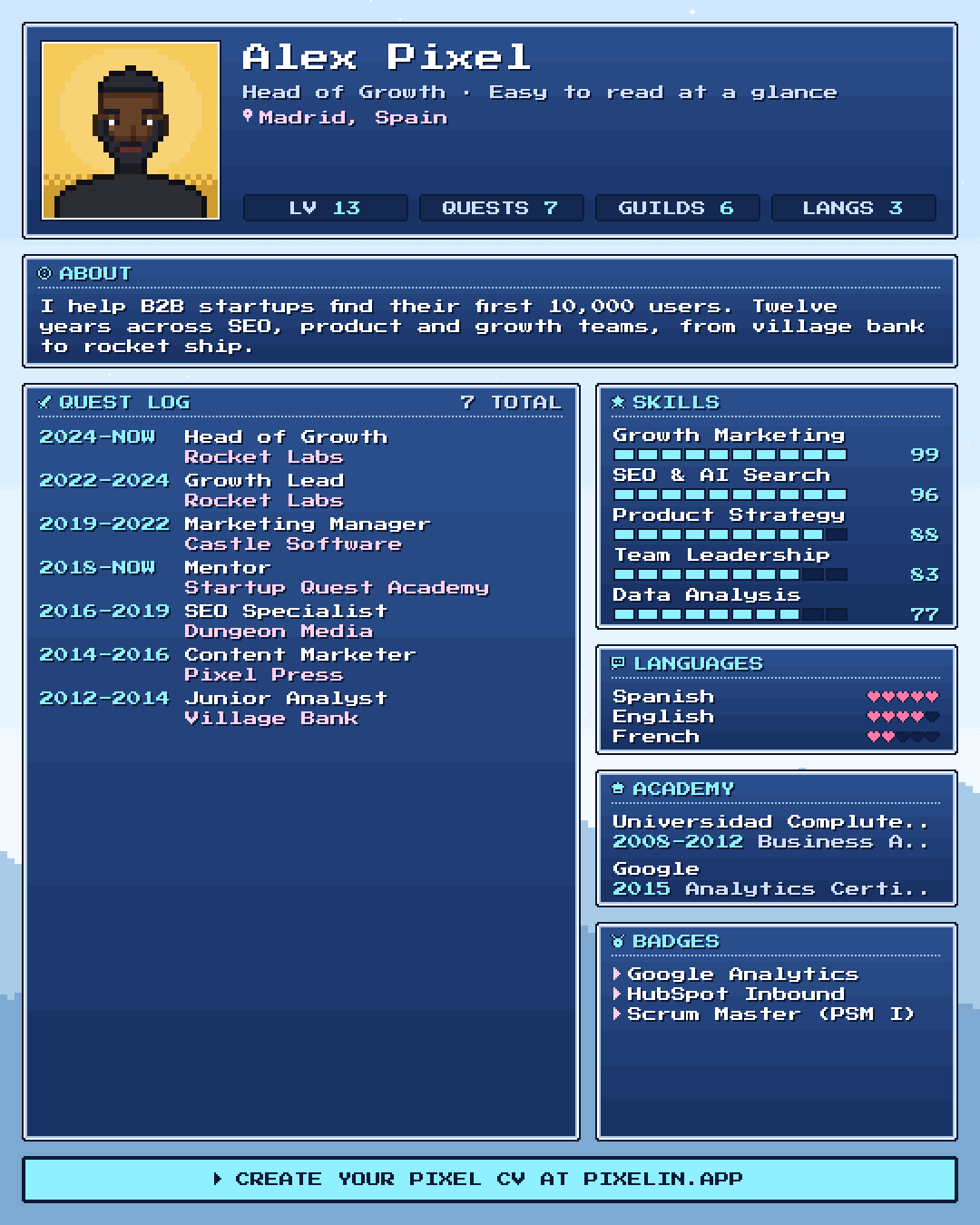
It is not a replacement for your resume. Use it as the image on a LinkedIn post when you are open to new roles. Save your profile as a PDF and drop it into Pixelin: it takes about a minute, and your PDF never leaves your browser.
FAQ
How long does a recruiter spend looking at a resume?
For the first screen, only a few seconds. Eye-tracking studies by the job site Ladders measured about 6 seconds in 2012 and 7.4 seconds in 2018. Resumes that pass that first look get read more carefully later, so the short scan is about getting through the door, not the whole decision.
What do recruiters look at first on a resume?
Your name, your current job title and employer, your previous title and employer, the dates of both, and your education. In the 2012 Ladders study, those six items took almost 80% of recruiters' time on each resume.
Does a typo really matter on a resume?
Yes. In a study of 445 recruiters, resumes with many spelling errors were 18.5 percentage points less likely to get an interview, and even a few errors cost 7.3 points. Another study of 536 recruiters found spelling errors hurt as much as a lack of experience.
Should I put a photo on my resume?
In the US, UK and Canada, no. A field experiment found photos changed callback rates depending on looks and gender, and women did best with no photo at all. In countries where a photo is expected, use a simple, professional one.
Is it true that ATS software rejects most resumes before a human sees them?
There is no reliable source for the often-quoted claim that 75% of resumes are rejected automatically. Most systems rank and sort applications rather than reject them, and the most common automatic filters are knockout questions about things like work authorization, location or a required license.

Written by
On the internet since 1995 and launching online products since 2009, from one of the first app marketing agencies to tools like Pixelin. Writes about LinkedIn, resumes and standing out online.