
The resume feels like it has always existed: a page or two, your jobs in reverse order, your education at the bottom. In fact it is a fairly recent invention, and it has changed shape every time the technology of hiring changed. Here is its story, from a Renaissance letter to the AI-written applications of today, with a source for every step.
About 1482 to 1485: Leonardo’s letter to the Duke of Milan
The story usually starts with Leonardo da Vinci. In his early thirties, newly arrived in Milan, he drafted a letter to the city’s ruler, Ludovico Sforza, offering his services. The draft survives in the Codex Atlanticus, held at the Biblioteca Ambrosiana in Milan.
It is a remarkable read. In ten points, Leonardo promises portable bridges, siege machines, tunnels, cannons and ways to destroy any fortress. Only in the last point does he mention that he can also paint and sculpt “as well as anyone”. He knew his audience: Milan was at war, and the duke needed engineers more than painters.
Two things are often told wrongly. The letter is not in Leonardo’s hand: the Ambrosiana says he had it written out by a professional copyist, and Museo Galileo describes it as the work of a friend or collaborator. And it is not really a resume. It lists no past jobs and no dates. It is closer to a cover letter: a pitch, tailored to one employer, about what he could do for them. Nobody knows whether it was ever sent.
Its lesson still holds, though. Lead with what the reader needs.
The words: “curriculum vitae” and “résumé”
Curriculum vitae is Latin for “course of life”, which is why academic CVs still try to list everything. Résumé is French for “summary”, from the verb résumer, to sum up, which comes from the Latin resumere (Wiktionary). English used it for any kind of summary before American English gave it its job-hunting meaning in the 20th century. The British kept “CV” for the same document, which is why the two words still confuse people. Our guide on CV vs resume sorts it out.
You may read that a 16th-century English lord, or Admiral Nelson, wrote the first “résumé”. There is no good source for either story.
Early to mid 20th century: a personal document
As offices grew and hiring became a job of its own, the resume slowly took its familiar shape. Accounts of the period, such as Workable’s history of the resume, describe resumes of the 1930s to 1950s that included things no one would put on one today: age, height, weight, marital status, religion, parents’ background and a photo.
1960s and 1970s: the personal details disappear, in the US
What changed this in the United States was the law. The Civil Rights Act of 1964 banned discrimination by race, colour, religion, sex and national origin, and the Age Discrimination in Employment Act of 1967 made it unlawful to publish job ads that show a preference based on age. The Equal Employment Opportunity Commission still advises employers to avoid questions that reveal these things, and says they should not ask for a photograph before an offer.
No law ever banned these details on a resume. But once employers stopped asking for them, candidates stopped including them, and the American resume became the lean, facts-only document it is today. Much of Europe and Asia took a different path, which is why a photo on a resume is still normal in some countries and a mistake in others.
1960s to 1990s: typewriters, word processors and fax
For decades a resume was typed, often on an electric typewriter, and copied. Changing a line meant typing the page again, so most people had a single version for every job. Personal computers and word processors changed that in the 1980s and 1990s: suddenly you could keep a file, adjust it for each application and print a fresh copy. By the late 1980s resumes were being faxed in bulk, and some candidates even sent videos on VHS.
1990 onwards: software starts reading resumes
As piles of paper grew, employers turned to software. By 1990, a company called Resumix was presenting what it called the world’s first intelligent resume-processing system, which scanned paper resumes and pulled out skills and experience. In 1996 the Christian Science Monitor reported that Unisys was scanning 5,000 to 7,000 resumes a month, and that Resumix was already giving candidates tips on keywords and fonts that its scanners could read.
Those were the first applicant tracking systems. Today they are everywhere: Jobscan found a detectable ATS at 487 of the Fortune 500 companies in 2026, with Workday alone used by more than 40%.
They also gave birth to a myth. You will often read that “75% of resumes are rejected by an ATS before a human sees them”. Fortune traced the figure in 2014 to a study by Preptel, a company that sold software to beat those systems, and no data behind it was ever published. Most ATS rank and sort resumes rather than throwing them out. We look at what really happens in our post on what recruiters look at on a resume.
1994 to 2004: job boards and email
The web moved the whole process online. The Monster Board started in 1994 and became Monster.com in 1999, the year it ran its first Super Bowl ad. Job boards let anyone post a resume once and be found by many employers, and email made applying a matter of minutes. By the mid-2000s, Indeed was gathering job ads from across the web into a single search, and it now has 685 million job seeker profiles.
In Europe, the EU created the Europass CV in December 2004, a common format meant to make skills and qualifications readable across countries. It was officially launched in January 2005.
2003 onwards: the resume that updates itself
LinkedIn launched on May 5, 2003, started a year earlier in co-founder Reid Hoffman’s living room. It turned the resume into something new: a public, always-on profile that recruiters search instead of waiting for you to apply. In October 2026 Microsoft said LinkedIn has more than 1.4 billion members.
For many people, the LinkedIn profile is now the master copy and the resume is the version you export for a specific job. That is exactly the step LinkedIn to Resume automates: it turns your LinkedIn profile PDF into a clean, ATS-friendly resume in about a minute. Our guide on how to put LinkedIn on your resume covers the link between the two.
2023 to today: AI on both sides
The newest chapter started in late 2022 with ChatGPT. Within months, 46% of job seekers in a Resume Builder survey said they had used it for their resume or cover letter. By 2026, 77% of US job seekers told Greenhouse they used AI in their search.
The result is an arms race. Applying became so easy that applications flooded in: The New York Times reported in 2025 that applications on LinkedIn were up more than 45% in a year, to about 11,000 a minute. Employers answered with AI of their own to screen them. In Greenhouse’s 2025 survey, 70% of hiring managers said AI made their decisions faster and better, but only 8% of job seekers thought it made hiring fairer.
Six in ten job seekers in the 2026 survey said they were rethinking how they write so they do not sound like AI. When every resume is polished, the ones that stand out are specific: real numbers, real projects, a voice that sounds like a person.
What 500 years of resumes teach
- Write for your reader. Leonardo put engineering first because that is what Milan needed. Lead with what the job asks for.
- Keep it short. The resume won because it is a summary, not a life story.
- Leave out what should not matter. Age, religion and looks were dropped for good reasons.
- Make it readable by people and machines. Since 1990, software has read resumes before humans do.
- Sound like yourself. In a world of AI-written applications, specific beats polished.
The next chapter, in pixels
If the resume is always changing, it can also be fun. A Pixel CV turns your LinkedIn profile into a 16-bit character card: your years of experience become your level, your skills turn into stat bars and your jobs fill a Quest Log. It is not a replacement for your resume, but it is a memorable image for a LinkedIn post about a new job or about being open to work.
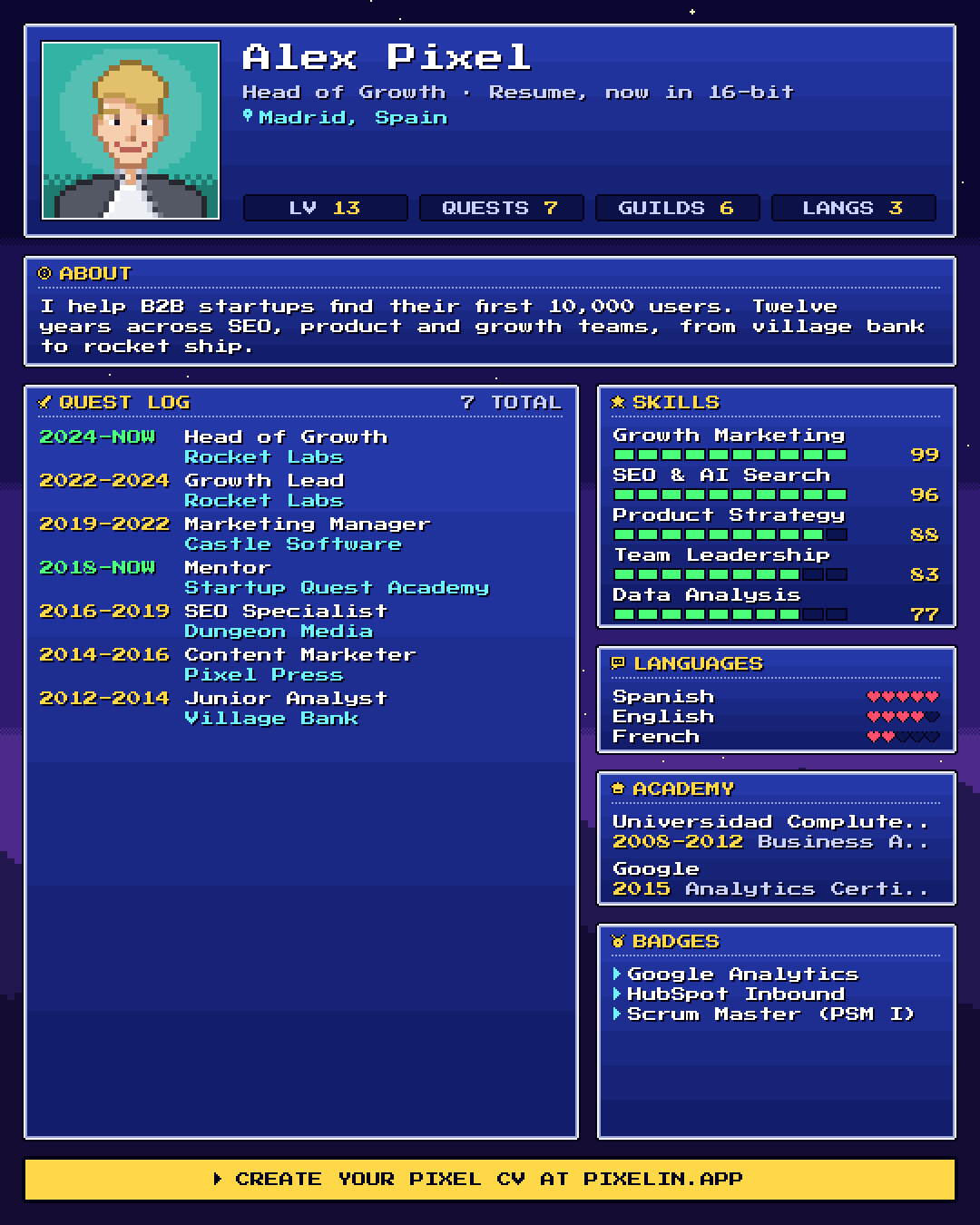
Save your LinkedIn profile as a PDF and drop it into Pixelin. It takes about a minute, and your PDF never leaves your browser.
FAQ
Who wrote the first resume?
Nobody invented it. Leonardo da Vinci's letter to Ludovico Sforza, from about 1482 to 1485, is often called the first resume, but it is really a letter pitching his skills, and it was written out by a copyist, not by Leonardo himself. Resumes as we know them took shape slowly in the 20th century.
What does résumé mean?
It is French for "summary", from the verb résumer, to sum up, which comes from the Latin resumere. American English took it to mean a summary of someone's career in the 20th century. Curriculum vitae is Latin for "course of life".
Why do US resumes not include a photo or age?
US anti-discrimination laws, mainly the Civil Rights Act of 1964 and the Age Discrimination in Employment Act of 1967, made employers stop asking for details like age, religion or a photo before an offer. No law bans them on a resume, but leaving them out became the norm.
Is it true that 75% of resumes are rejected by ATS software?
No reliable data supports it. The figure is usually traced back to marketing by a company that sold resume optimization software in the early 2010s, which never published how it was measured.
When did LinkedIn start?
LinkedIn launched on May 5, 2003. Microsoft said in October 2026 that it has more than 1.4 billion members.

Written by
On the internet since 1995 and launching online products since 2009, from one of the first app marketing agencies to tools like Pixelin. Writes about LinkedIn, resumes and standing out online.