
“CV” and “resume” are often used as if they meant the same thing, and in much of the world they do. In the US and Canada, though, they are two different documents, and sending the wrong one can make an application look off. Here is the difference in plain terms.
The short answer
- Resume: a short summary of your experience and skills, tailored to one job. Usually one or two pages. Standard for most jobs in the US and Canada.
- CV (curriculum vitae): in the US, a complete record of your academic and professional history, with no length limit. Used for academia, research, medicine and some grants. In the UK, Europe and many other countries, “CV” is simply the everyday word for a resume.
Side by side
| Resume | CV (US sense) | |
|---|---|---|
| Length | 1–2 pages | As long as needed, often many pages |
| Purpose | Get a specific job | Show your full academic and professional record |
| Tailored? | Yes, for every application | Mostly the same, updated over time |
| Typical content | Summary, experience, skills, education | Education, research, publications, teaching, grants, awards, talks |
| Used for | Most private-sector jobs | Academia, research, medicine, fellowships, grants |
What goes in a resume
A resume is a highlight reel. It usually includes:
- Contact details and links (LinkedIn, portfolio)
- A two- or three-line summary
- Relevant experience, newest first, with results and numbers
- Key skills for the role
- Education and certifications
Anything that does not help with this job can go. For ideas on making it count, see how to make your resume stand out.
What goes in a CV (US sense)
An academic CV is the opposite: complete rather than selective. Beyond education and positions, it lists publications, conference talks, research projects, teaching, grants, awards, professional memberships and sometimes references. It grows with your career and is rarely cut down.
How the terms change around the world
- US and Canada: resume for most jobs; CV for academic, research and medical roles.
- UK and Ireland: “CV” is the normal word for a resume-style document of about two pages.
- Most of Europe: “CV” again means a resume. Some countries have local conventions, such as including a photo, and the EU’s Europass CV format is common in some sectors.
- Australia, New Zealand, South Africa and India: both words are used, often interchangeably, for a resume-style document.
When in doubt, follow the job posting. If it asks for a CV for a regular job in Europe, send your resume. If a US university asks for a CV, send the full academic version.
Which one do you need?
- Applying for a typical job in the US or Canada? A resume.
- Applying for a faculty, research, medical or grant position in the US? A CV.
- Applying in the UK, Europe or elsewhere? A “CV” that is really a resume, unless the role is academic.
For the resume-style version, your LinkedIn profile is a good start. LinkedIn to resume builds it from your profile PDF as an A4 PDF, the standard paper size outside the US and Canada, with an optional photo for countries where one is expected. An academic CV is too long and specific for that: build it by hand from your full record.
Where a Pixel CV fits
Pixelin’s Pixel CV borrows the name but plays a different role. It is not something you attach to an application. It is a visual, 16-bit summary of your LinkedIn profile, made to be shared and noticed in the LinkedIn feed, wherever you are in the world.
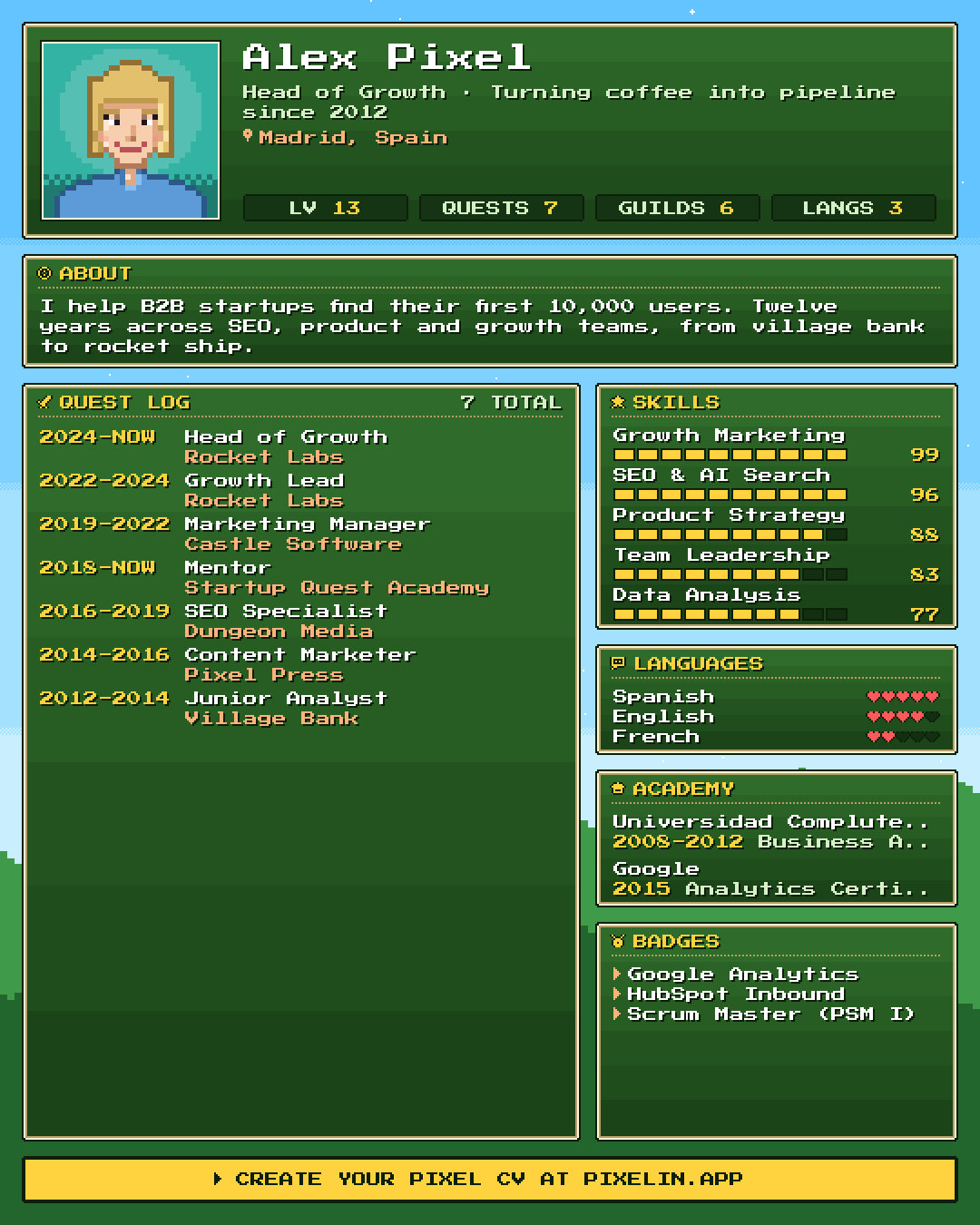
Use your resume or CV for applications, and a Pixel CV to get seen. Make yours from your LinkedIn PDF. For everything else you can do with that PDF, here is how to turn your LinkedIn profile into a resume.
FAQ
Is a CV the same as a resume?
In the US and Canada, no. A resume is a short, tailored summary for a job, while a CV is a long, complete record used mostly in academia, research and medicine. In the UK, Ireland and most of Europe, "CV" simply means what Americans call a resume.
What does CV stand for?
CV stands for curriculum vitae, Latin for "course of life". The name reflects its purpose in the US sense, a complete record of your career.
How long should a CV be compared to a resume?
A resume is usually one or two pages. An academic CV has no fixed length and grows over a career, often to many pages, because it lists every publication, grant and talk.
Should I send a CV or a resume?
Follow the job posting and the country. For most jobs in the US and Canada, send a resume. For academic, research or medical roles in the US, or for jobs in the UK and Europe, send a CV, which in Europe means a resume-style document.
Is a Pixel CV a CV or a resume?
Neither, strictly. A Pixel CV is a visual, shareable summary of your LinkedIn profile, designed to get noticed in the LinkedIn feed. It complements the resume or CV you send with applications.

Written by
On the internet since 1995 and launching online products since 2009, from one of the first app marketing agencies to tools like Pixelin. Writes about LinkedIn, resumes and standing out online.