
Most employers don’t want references on your resume. They ask for them later, usually after the final interview or just before an offer, and they want them fast. If you have a reference page ready by then, you look organised and the process keeps moving. If you don’t, you end up messaging old managers in a hurry and sending a list with an out-of-date phone number.
Below is a reference page template you can copy, what to write for each person, examples for different situations, and the two emails you need: one to ask someone to be your reference and one to send the list to an employer.
Not sure whether references belong on your resume in the first place? We cover that in should you put references on a resume. This guide is about the list itself.
Reference page template
Copy this, replace the details with yours, and save it as a one-page PDF.
Jordan Rivera Chicago, IL · (312) 555-0187 · jordan.rivera@example.com · linkedin.com/in/jordanrivera
Professional References
Priya Shah Senior Operations Manager, Lakeside Freight Former direct manager (2022–2025) priya.shah@example.com · (312) 555-0123 Can speak to: the carrier onboarding program I led and my work with the warehouse team.
Marcus Bell Logistics Director, Northline Distribution Former team lead (2019–2022) marcus.bell@example.com · (773) 555-0164 Can speak to: day-to-day scheduling, vendor relationships and how I handled peak season.
Dana Okafor Account Manager, Brightway Retail (client) Client contact (2023–2025) dana.okafor@example.com · (312) 555-0119 Can speak to: on-time delivery, problem solving and communication with a key account.
That’s the whole thing: your header, a title, and three references, each in the same five-line format. It should fit easily on one page.
What to include for each reference
| Line | Example | Tips |
|---|---|---|
| Full name | Priya Shah | The name they use at work. |
| Current job title and company | Senior Operations Manager, Lakeside Freight | Their title today, even if they have moved on since you worked together. |
| How you know them, with dates | Former direct manager (2022–2025) | The line employers look at first. “Manager” beats “colleague”, and recent beats old. |
| Email and phone | Work email, mobile | The contact details they prefer. Ask; many people would rather get an email first. |
| What they can speak to (optional) | The onboarding program I led | One line that tells the employer what to ask about, and reminds your reference too. |
Leave out home addresses, ages, photos and anything personal your reference hasn’t agreed to share. If someone has asked to be contacted by email only, write just the email.
How to put your reference page together
- Use the same header as your resume. Same name, contact details, font and colours, so the two documents look like a set. If you make your resume with LinkedIn to resume, copy its header line.
- Title it simply: “References” or “Professional References”. Nothing else is needed.
- Put your strongest reference first, usually your most recent direct manager, or whoever knows the work closest to the job you’re applying for.
- Stop at three unless the employer asks for more. Keep one or two extra people in reserve.
- Check every detail. People change jobs and numbers. A quick message (“Is this still the best number for you?”) avoids a dead end.
- Save it as a PDF with a clear name, such as Jordan-Rivera-References.pdf.
- Send it only when asked, and tell your references it’s on its way (more on that below).
Examples for different situations
The template works for almost everyone. What changes is who you list and how you describe the relationship.
Your first job (no work experience)
Employers know you don’t have a former manager yet. They want people who have seen you show up, work hard and get along with others:
Ms. Laura Chen Biology Teacher, Westfield High School Teacher and science club advisor (2023–2025) l.chen@example.edu · (630) 555-0148 Can speak to: reliability, leading the robotics team’s fundraising and working under deadlines.
Good choices: a teacher, a professor, a sports coach, a volunteer coordinator, the person who supervised your internship or babysitting family you worked for regularly. Our guide to a resume with no experience has more on making the most of this kind of background.
Changing careers
Choose people who saw the skills that carry over to the new field, and use the last line to make that link clear:
Tom Alvarez Principal, Lincoln Elementary School Former principal (2018–2025) tom.alvarez@example.org · (414) 555-0172 Can speak to: designing the school’s new reading curriculum and training 12 teachers on it, which is the work I’m moving into as an instructional designer.
The employer may otherwise wonder why a school principal is your reference for a corporate job. One sentence answers that. See transferable skills for how to describe what carries over.
Your current employer doesn’t know you’re looking
You don’t have to list your current manager. Use a former manager or a colleague who has since left, and if you do include someone from your current job, add a clear note:
Ana Petrova Product Lead, Corvid Software (current employer) Current manager (2024–present) ana.petrova@example.com · (206) 555-0131 Please contact only after an offer has been made.
Recruiters see this all the time. They will respect it, and it’s better than an awkward surprise for your manager.
Academic CVs and UK-style referees
On an academic CV, and in many UK and public-sector applications, references are called referees and are often expected. List two or three at the end of the CV under “Referees”, with their full title and institution:
Professor Helen Ward Professor of Molecular Biology, University of Leeds PhD supervisor (2020–2024) h.ward@example.ac.uk · +44 113 496 0000
Application forms often have their own referee boxes. If they do, fill those in rather than attaching a separate page. The differences between the two documents are covered in CV vs resume.
Character (personal) references
Some employers ask for one personal reference on top of your professional ones, especially for childcare, care work, volunteering and some public-sector jobs. Pick someone who has known you for years, isn’t a relative and can describe your character honestly: a former teacher, a mentor, a long-time neighbour or the leader of a group you belong to.
Rev. Michael Grant Community Program Director, Eastside Community Center Known me for eight years through the center’s youth program m.grant@example.org · (215) 555-0156
Keep character references clearly separate, under a heading such as “Personal Reference”, so employers don’t mistake them for professional ones.
How to ask someone to be your reference
Ask before you list anyone, and ask again when you apply somewhere new. A short, specific email is easiest to say yes to:
Subject: Would you be a reference for me?
Hi Priya,
I hope you’re well. I’m applying for an Operations Manager role at Harbor Logistics, and I’d love to list you as a reference. You saw my work up close on the carrier onboarding program, which is very close to what this job involves.
If you’re happy to, could you confirm the best email and phone number to give them? I’ll let you know before they get in touch, and I’m glad to send you the job description and a copy of my resume.
Thank you either way, Jordan
If you’re in regular contact, a quick message works too:
Hi Marcus! I’m applying for a logistics role at Harbor and would love to put you down as a reference. Would that be OK? Happy to send you the details.
If someone hesitates, or says they don’t remember your work well, thank them and ask someone else. A lukewarm reference is worse than a different one.
How to send your references to an employer
When a recruiter asks for your references, reply the same day if you can, with the PDF attached:
Subject: References – Jordan Rivera, Operations Manager
Hi Sam,
Thank you for the update. As requested, I’ve attached my references: Priya Shah (my former manager at Lakeside Freight), Marcus Bell (my former team lead at Northline) and Dana Okafor (a client contact at Brightway Retail). All three are expecting to hear from you.
Please let me know if you need anything else.
Best regards, Jordan Rivera
Then message each reference straight away: who will contact them, for which job, and the one or two things that matter most for the role. They’ll give a better, more specific answer if they’ve had a moment to think about it. The employer’s side of this is described in reference check.
Mistakes that cost offers
- Listing someone who hasn’t agreed. The most common mistake, and the easiest to avoid.
- Out-of-date contact details. An employer who can’t reach your reference may simply move on to another candidate.
- Not warning your references. A call out of the blue gets a vague, hesitant answer.
- Only friends and family. Employers want people who have seen you work. A friend is fine only if they were also your colleague or manager.
- Stretching the relationship. Don’t call a colleague your “manager”. Reference checks often ask exactly that question.
- Writing “references available upon request” on your resume. Employers already assume it, so the line just takes up space.
After the reference check
Whatever happens, thank your references and tell them how it went. A short note takes a minute, and it makes them happy to help again next time. If you get the job, a LinkedIn recommendation in return, or simply a public thank-you, is a nice way to close the loop.
Let your LinkedIn speak first
Long before an employer calls your references, they’ll usually look you up on LinkedIn. Recommendations on your profile work like references anyone can read, and a clear profile backs up everything your references will say.
A Pixel CV is a fun way to share that profile: a 16-bit, RPG-style card with your roles in a Quest Log, your years of experience as your level and your skills as stat bars.
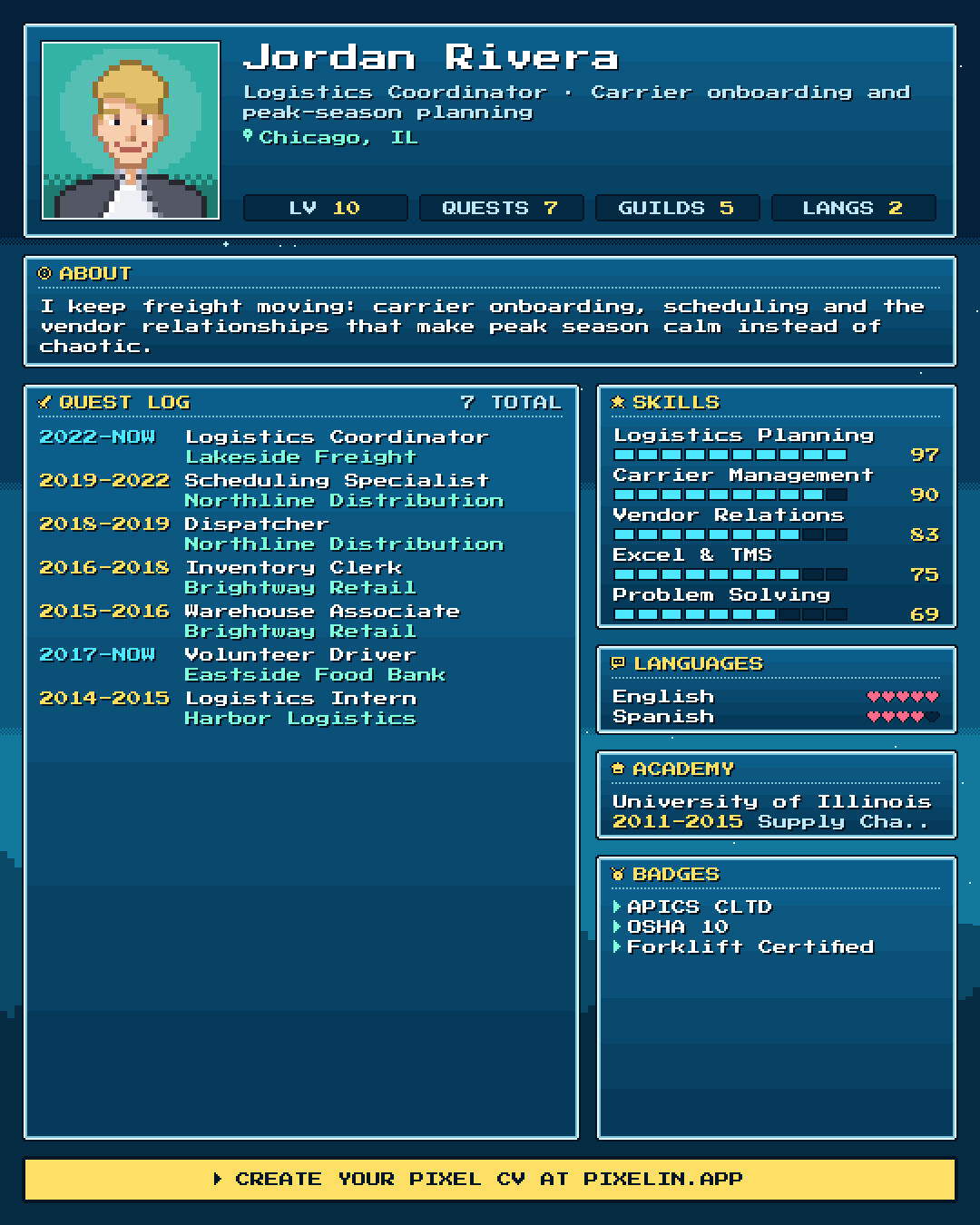
Save your LinkedIn profile as a PDF and drop it into Pixelin to make yours in under a minute. It’s free, and your file never leaves your browser.
FAQ
How many references should I list?
Three is the usual number. Some employers ask for two, some for four or five, and some want one to be your most recent manager. Keep one or two extra people ready in case someone is on holiday or doesn't reply.
Should references go on the same page as my resume?
No, unless the employer asks for that. Put them on a separate page with the same header as your resume and send it only when you are asked. Your resume's space is better used for your experience.
Do I need to include my references' home addresses?
No. Older templates included postal addresses, but today a work email and a phone number are enough. Never share personal details your references haven't agreed to give out.
Can I list someone as a reference without asking them?
No. Always ask first, every time you apply somewhere new. A reference who is surprised by the call, or who has forgotten your work, can do more harm than having no reference at all.
What is the difference between a reference page and a reference letter?
A reference page is a list you write, with the names and contact details of people who agreed to speak about you. A reference letter (or letter of recommendation) is written by one of those people and describes your work in their own words.
What if my references work at my current company?
Make it clear in the list. Add a short note such as "please contact only after an offer is made" next to them, or offer a former colleague who has left the company instead, so your search stays private.

Written by
On the internet since 1995 and launching online products since 2009, from one of the first app marketing agencies to tools like Pixelin. Writes about LinkedIn, resumes and standing out online.