
The skills on your resume do two jobs. They help applicant tracking systems (ATS) match you to a role, and they show a recruiter in seconds what you can do. The trick is not to list everything you know, but the right skills for this job, backed by proof. Here is how to choose them, with examples you can adapt.
Hard skills vs soft skills
- Hard skills are specific and teachable: tools, methods, languages, certifications. Excel, SQL, SEO, Figma, bookkeeping, Spanish.
- Soft skills are how you work: communication, leadership, problem-solving, adaptability, collaboration.
Most strong resumes lead with hard skills in the skills section and prove soft skills through experience.
How to choose the right skills
- Read the job description and highlight every skill it mentions, especially in the requirements.
- Keep the ones you really have. Never list a skill you could not discuss in an interview.
- Use the job’s exact words. If it says “project management”, write that, not only “PM”.
- Prioritize. Put the skills the role mentions most first.
Hard skills by field (examples)
Software and data: Python, JavaScript, SQL, cloud platforms (AWS, Azure, Google Cloud), Git, APIs, data analysis, machine learning, testing.
Marketing: SEO, content strategy, paid social, Google Ads, email marketing, marketing analytics, copywriting, CRM tools, A/B testing.
Sales: prospecting, negotiation, pipeline management, CRM (for example Salesforce or HubSpot), account management, forecasting.
Finance and accounting: financial modeling, budgeting, forecasting, reconciliation, Excel (advanced), accounting software, compliance.
Design: Figma, Adobe Creative Cloud, UI/UX design, prototyping, typography, design systems, user research. Designers, see the graphic designer resume guide for how to list them without skill bars.
Healthcare: patient care, electronic health records (EHR), medication administration, CPR certification, medical terminology.
Customer service: ticketing systems, live chat support, conflict resolution, product knowledge, customer retention.
Operations and admin: scheduling, process improvement, inventory management, vendor management, data entry, Microsoft 365 or Google Workspace.
To see skills in the context of a whole resume, browse our resume examples by job: each one has a skills section for its field.
Soft skills that recruiters value
Communication · Leadership · Problem-solving · Teamwork · Adaptability · Time management · Attention to detail · Critical thinking · Creativity · Emotional intelligence
Instead of listing these alone, prove them in your experience:
- Leadership → “Led a team of five to launch the new onboarding flow two weeks early.”
- Problem-solving → “Cut support tickets 30% by fixing the three most common checkout errors.”
- Communication → “Presented monthly results to the executive team.”
How many skills, and where to put them
- Six to twelve in a dedicated skills section is plenty for most roles.
- Group them if you have many, for example Tools, Languages, Certifications.
- Repeat the key ones in your experience bullets, where they come with context and results.
- Mention one or two in your summary, the first thing recruiters read. See our resume summary examples.
Skills to leave out
- Basics everyone assumes, such as “Microsoft Word” or “email” for most office jobs.
- Outdated tools nobody uses anymore.
- Vague labels without proof: “hard-working”, “go-getter”, “team player”.
- Skills you cannot back up in an interview.
Don’t forget your LinkedIn skills
Recruiters search LinkedIn by skill, so your profile’s skills matter as much as your resume’s. Add your key skills, keep them consistent with your resume, and choose your top skills carefully: they are the first ones people see.
They are also the skills in your LinkedIn PDF. LinkedIn to resume carries them onto a one-column resume with the rest of your profile; add the others the job asks for in the preview before you download it.
And they are what a Pixel CV turns into stat bars on a 16-bit, RPG-style card you can share on LinkedIn to get noticed.
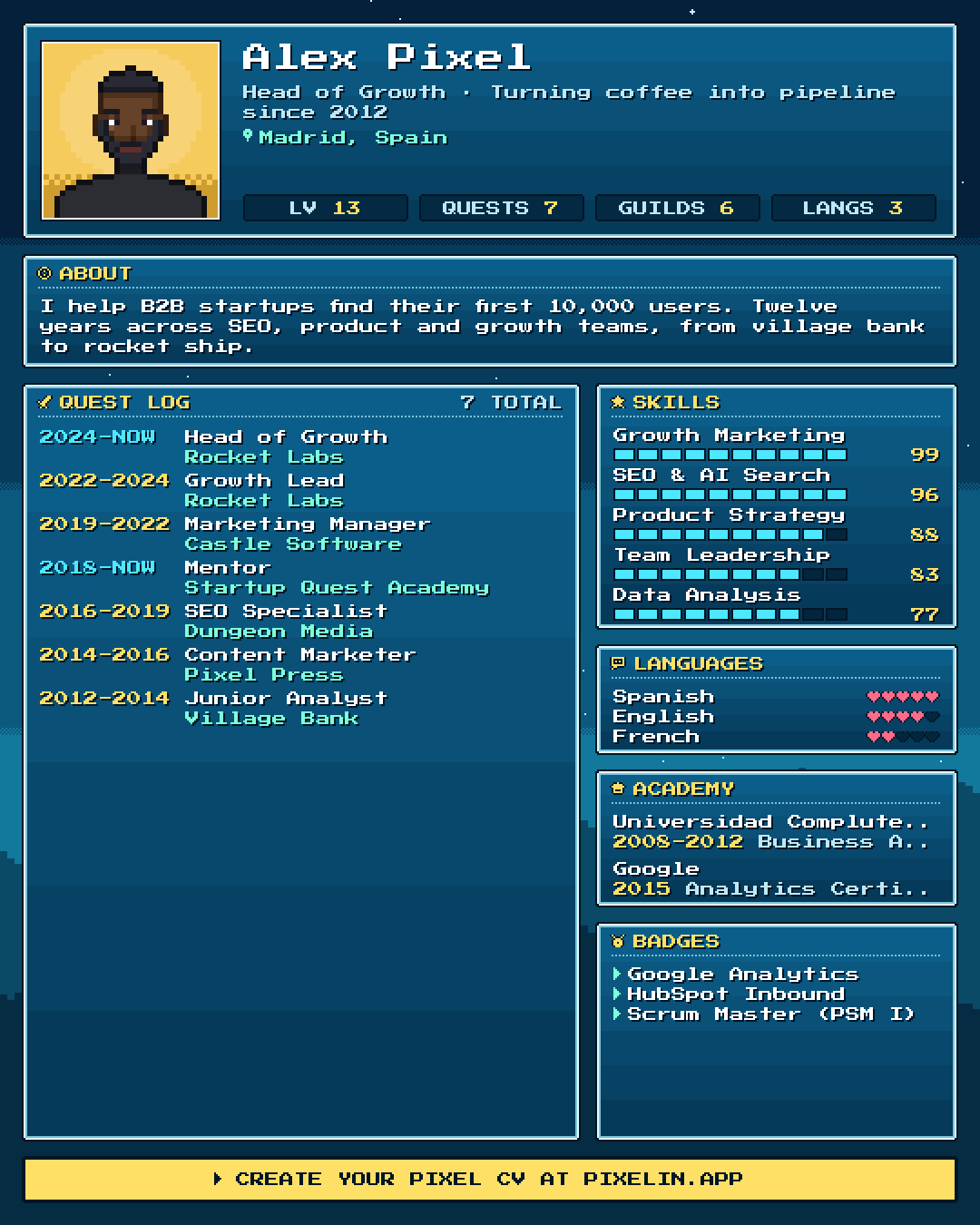
Drop the same PDF into Pixelin to see how yours look. Writing your first resume? Skills carry even more weight there: see how to make a resume with no experience.
FAQ
How many skills should I put on a resume?
Usually six to twelve in a skills section, chosen for the job you are applying to. Fewer, relevant skills read stronger than a long list nobody will check.
What is the difference between hard and soft skills?
Hard skills are specific, teachable and easy to test, such as Python, bookkeeping or Figma. Soft skills are how you work with people and problems, such as communication, leadership or adaptability.
Should I put soft skills on my resume?
Yes, but show them rather than just list them. "Led a team of five" proves leadership better than the word "leadership" in a list.
Where do skills go on a resume?
In a short skills section, usually after your summary or experience, and again inside your experience bullets where they have context and results.
Do skills on LinkedIn matter too?
Yes. Recruiters search LinkedIn by skill, so list your key skills there and keep them consistent with your resume. Your top skills also appear on a Pixel CV as stat bars.

Written by
On the internet since 1995 and launching online products since 2009, from one of the first app marketing agencies to tools like Pixelin. Writes about LinkedIn, resumes and standing out online.