
Your About section, which LinkedIn used to call the summary, is the only place on your profile where you explain yourself in your own words. The headline says what you do; the About says why it matters, how you work and what you want next.
Most people either leave it empty or paste their resume summary into it. Both waste it. Below is a simple template, 18 examples by job and situation, and the details that decide whether anyone reads past the first line.
The limit, and the two lines that matter
LinkedIn currently allows up to 2,600 characters in About, roughly 400 words. You’ll rarely need all of them.
What matters far more is the opening. On your profile, only the first two or three lines (around 250 to 300 characters, depending on the screen) show before “…see more”. Most visitors won’t click. So the first lines have to work on their own:
- Weak opening: “I am a dedicated and passionate professional with over ten years of experience in a variety of roles across multiple industries…”
- Strong opening: “I help hospitals cut patient wait times. Over eight years, I’ve redesigned scheduling for 14 clinics and brought average waits down from 52 to 19 minutes.”
The strong version names a problem, a result and a number in two sentences. If someone stops reading there, they still know what you do.
A template you can fill in
Most good About sections follow the same five steps. Use them in order, one short paragraph each:
- Hook: what you do and for whom, in one or two sentences.
- Proof: two or three results, projects or achievements, with numbers where you honestly have them.
- How you work: what you’re known for, your approach, what colleagues come to you for.
- Skills and keywords: the tools, specialisms and titles people in your field search for.
- What’s next: what you’re looking for, or how people should contact you.
As a fill-in version:
I help [who] [do what / solve what problem].
Over [X years], I’ve [result 1], [result 2] and [result 3].
I’m known for [strength]. My favorite work is [type of project].
Skills: [skill] · [skill] · [tool] · [tool]
I’m currently [open to / looking for / building]. The best way to reach me is [email / message].
Examples by job
All names, companies and numbers below are made up. Use the structure, not the facts.
Software engineer
I build backend systems that move money, and I like them boring: fast, predictable and easy to change.
For the last six years I’ve worked on payments at two fintech companies. I led the move of our card-processing service to Go, which cut response times by 40%, and designed the retry system that now handles 2 million transactions a day without manual fixes.
I’m happiest pairing with product and support to find the real cause of a problem, and I write the docs I wish I’d had.
Python · Go · PostgreSQL · Kafka · AWS · Terraform
Open to senior backend roles in Europe, remote or hybrid.
Data analyst
I turn messy sales data into decisions people actually make on Monday morning.
At a national retailer, I built the weekly pricing dashboard that the commercial team now uses in every trading meeting, and an Excel model that found $1.2M a year in markdowns we didn’t need.
I care about explaining numbers clearly to people who don’t love spreadsheets. SQL, Python, Tableau, Power BI, Excel.
Interested in analytics roles in retail and e-commerce.
Product manager
I’ve spent eight years turning “users keep asking for this” into products people pay for.
I took a mobile budgeting app from beta to 1.1M users, and later led the team that rebuilt onboarding, raising activation from 31% to 54%. Before product I was a support lead, which is why I still read every week’s tickets.
I work best with small teams that ship often and talk to customers more than to each other.
Currently Senior PM, Growth. Always happy to talk about onboarding, pricing and experiments.
Marketing manager
I help B2B software companies get found by the people who will buy from them.
At Northbeam I built the content and SEO program from zero: organic sign-ups grew from 500 to 9,000 a month in three years, with a team of three. Before that I ran demand generation at two agencies.
I like marketing that’s measurable and honest. If a campaign doesn’t work, I’d rather know in week two than week ten.
SEO · Content strategy · HubSpot · Paid search · Webinars · Team leadership
Sales / account executive
I sell logistics software to companies that move a lot of boxes, and I spend most of my time listening to how they actually move them.
130% of quota in 2025 and 118% in 2024. I opened our first accounts in Germany and Poland and now look after 40 mid-market customers.
If you run operations at a distribution company and your freight costs keep climbing, I’m happy to compare notes, no pitch required.
Recruiter
I hire engineers and product people for early-stage startups, mostly in Berlin and remote across Europe.
Over seven years I’ve filled 230+ roles, from first engineers to CTOs. I reply to every candidate, even when the answer is no.
Now hiring: Senior Backend Engineer, Product Designer, Engineering Manager. Message me here or email jobs@northbeam.example.
Registered nurse
Registered Nurse with eight years in intensive care, the last five in a Level I trauma center.
I precept new graduates on our unit, sit on the sepsis quality committee and helped introduce a handover checklist that cut medication errors at shift change.
I’m calm under pressure and good at explaining hard news to families in plain words.
BSN · CCRN · ACLS · PALS. Interested in critical care education and clinical informatics.
Teacher
I’ve taught high school math for ten years, and my favorite moment is still when a student who “isn’t a math person” gets it.
I redesigned our algebra course around projects and small-group work, and pass rates rose from 68% to 84% in two years. I also run the school’s coding club.
I’m curious about how EdTech can help teachers spend less time on admin and more with students.
Project manager
I keep construction projects on time and on budget, and I tell clients early when they won’t be.
PMP-certified, with 12 years managing mid-rise residential and commercial builds up to $60M. My last four projects finished within 3% of budget.
Procore · MS Project · Primavera P6 · Contract management · Stakeholder reporting
Administrative / executive assistant
I make busy leaders’ days run smoothly, so they can focus on the work only they can do.
For the past six years I’ve supported a CEO and two VPs: calendars across five time zones, board meetings, international travel and confidential projects. I set up the office’s shared booking system that the whole team now uses.
Organized, discreet and quick with Microsoft 365, Google Workspace and Notion.
Customer success manager
I help software customers get what they paid for, which is usually the best way to keep them.
I look after 60 accounts worth $3.4M a year, with 98% gross retention. I built our onboarding playbook, which cut time to first value from 45 to 18 days.
I’m the person customers call when something’s wrong, and I like it that way.
Freelancer / consultant
I’m a freelance brand designer for food and drink startups: logos, packaging and brand systems that look good on a shelf and on a phone.
Over the last five years I’ve worked with 40+ brands, from a two-person hot-sauce company to a coffee chain with 30 shops.
→ Portfolio and case studies in Featured, below → Booking projects from February → hello@yourname.example
Examples by situation
Student
Third-year Computer Science student at Georgia Tech, most interested in backend and cloud.
I built a campus bus-tracking app that 2,000 students use, interned at a logistics startup last summer, and help run our university’s hackathon.
Python · Java · React · SQL · AWS (Cloud Practitioner)
Looking for a Summer 2027 software engineering internship.
Recent graduate
Marketing graduate who learned the most outside the classroom: I grew my university’s student magazine Instagram from 800 to 11,000 followers and ran social media during two internships in consumer brands.
I write fast, test everything and like learning from data.
Looking for a first role in social media or content marketing. Portfolio in Featured.
Career changer
After nine years as a high school teacher, I’m moving into instructional design.
Teaching taught me how people learn, how to plan a curriculum and how to keep a room engaged. Over the last year I’ve added the tools: Articulate 360, Rise and Camtasia, and a portfolio of four eLearning modules, including a compliance course now used by a regional nonprofit.
I’m looking for instructional design or L&D roles where classroom experience is a plus, not a footnote.
Job seeker
Customer success manager with six years in B2B SaaS, now looking for my next team after our company was acquired.
I’ve looked after up to 60 accounts at a time, kept gross retention above 95% and built onboarding that customers still mention in reviews.
Open to remote CSM or Account Manager roles in Europe. Happy to share references, and grateful for any introductions.
Returning after a break
Office manager returning to work after three years caring for my family.
Before my break, I ran operations for a 40-person architecture firm: suppliers, budgets, hiring admin and the office move nobody else wanted to plan. During it I kept my skills current, completing courses in Excel and bookkeeping and volunteering as treasurer for a local school.
Looking for office or operations roles, full-time or part-time, in Manchester.
Founder
I’m building Northbeam, a scheduling tool that helps clinics cut no-shows. We work with 140 clinics in three countries.
Before Northbeam I spent eight years in hospital operations, where I saw how much a missed appointment really costs.
We’re hiring engineers. If you care about healthcare and calm software, I’d love to talk.
How to format it
LinkedIn’s About field is plain text, but a few tricks make it easier to read:
- Short paragraphs. One to three sentences each, with an empty line between them.
- Symbols as bullets. Type “•”, “→” or “–” at the start of a line. They show up fine on every device.
- A skills line. Separate skills with “·” or “|”. It’s easy to scan and helps with search.
- First person. “I”, not your name. It reads like a person, not a press release.
- A clear ending. What you’re looking for, or how to contact you. Many good About sections end with an email address.
- Use Featured for links. Put your portfolio, articles or projects in the Featured section, right below About, and point to it.
Mistakes to avoid
- Leaving it empty. About is one of the few places on your profile with room for keywords and context.
- Pasting your resume. A list of past jobs is already in your Experience section. About is for the story that connects them.
- A slow start. “I am a dedicated professional…” wastes the only lines most people read.
- Clichés without proof: “results-driven”, “passionate”, “team player”. Show it with a result instead.
- Writing for everyone. Pick the reader you most want (a recruiter in your field, a client, a hiring manager) and write for them.
- Out-of-date goals. If you’ve found a job, remove “open to new roles”.
From resume summary to About, and back
Your resume summary and your About section start from the same idea. The difference is room and tone: a resume summary is three or four tight lines with no “I”; About can be longer, warmer and in the first person. A good approach is to write one and adapt it into the other. For a shorter definition, see LinkedIn summary.
It also works the other way round. LinkedIn to Resume uses your About section as the summary of a classic, ATS-friendly resume, so you can start from it and cut it down.
To edit About, open your profile and click the pencil icon in the About section. If you don’t have one yet, use Add profile section at the top of your profile. Then finish the set with these LinkedIn headline examples and LinkedIn banner ideas, including six free pixel-art banners.
See your About on a Pixel CV
On a Pixel CV, the first lines of your About go into the About box near the top of a 16-bit, RPG-style card, just like on your profile, only the opening fits. It’s a quick test: if those lines say who you are, your About is doing its job.
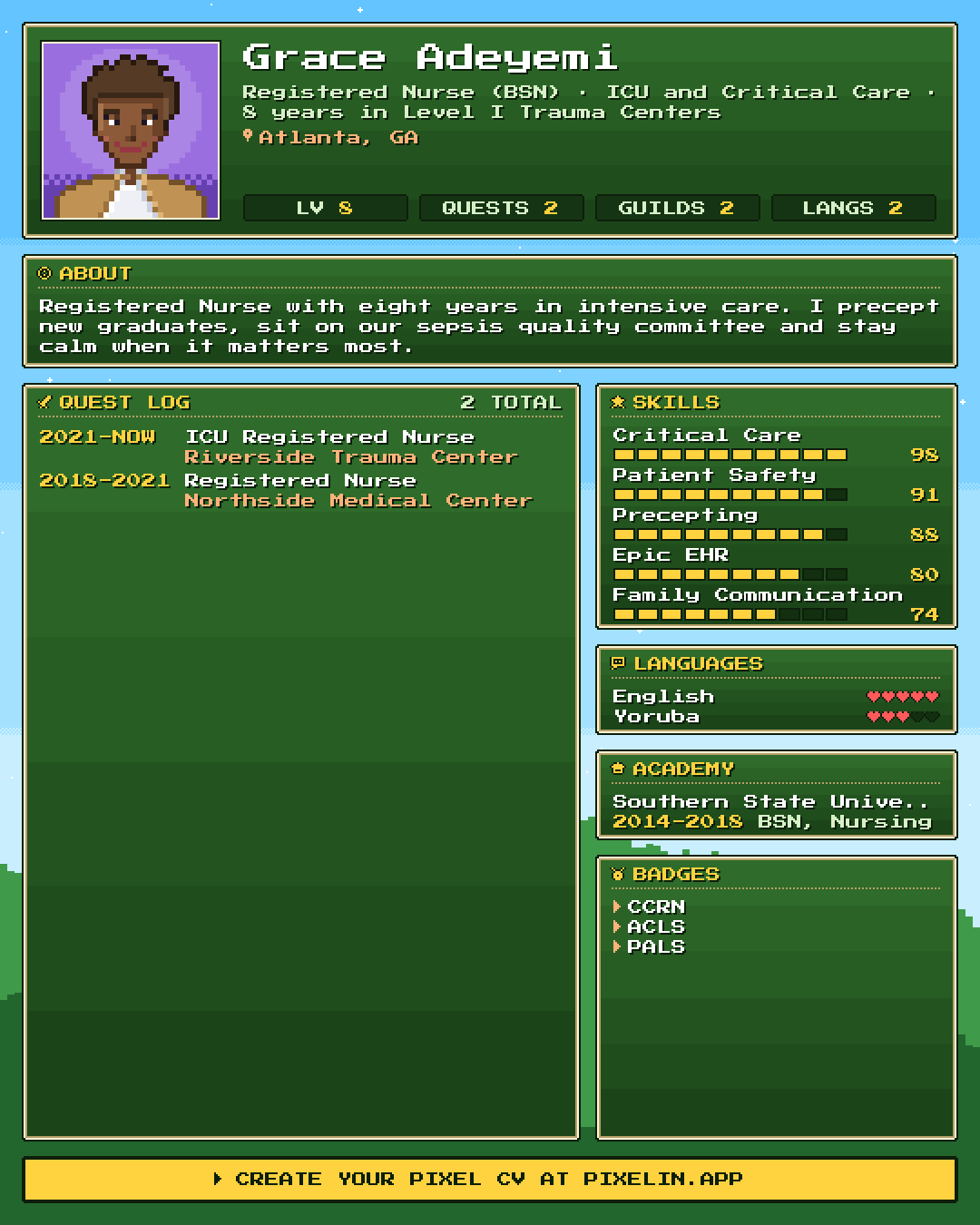
Pixelin makes one from your LinkedIn PDF in under a minute, free, without the file leaving your browser.
FAQ
How long should my LinkedIn About section be?
The limit is 2,600 characters, but most good About sections are 150 to 300 words, in three to five short paragraphs. What matters most is the opening, because only the first two or three lines show before "see more".
Should I write my LinkedIn About section in the first or third person?
First person. LinkedIn is a conversation, and "I help clinics cut no-shows" sounds like a person, while "Maria helps clinics cut no-shows" sounds like a press release. The third person mostly survives on company pages and some executive profiles.
Is the LinkedIn summary the same as the About section?
Yes. LinkedIn used to call it the summary and now shows it as About. Many people still search for "LinkedIn summary examples", and the advice is the same.
Should I include keywords in my About section?
Yes, naturally. Mention the job titles, skills and tools that people in your field search for, in full sentences or in a short "Skills" line at the end. Don't stuff the text with them; it reads badly and recruiters notice.
Can I use bullet points and emoji in my About section?
LinkedIn doesn't format text, but you can type symbols like "•" or "→" and line breaks, and they show up. Short lists help people scan. Use emoji sparingly, as small markers at most.
What should a student or someone with no experience write in About?
What you're studying, what you've done that shows skill or effort (projects, part-time jobs, volunteering, clubs) and what kind of role you're looking for. Short and specific beats long and vague.

Written by
On the internet since 1995 and launching online products since 2009, from one of the first app marketing agencies to tools like Pixelin. Writes about LinkedIn, resumes and standing out online.