
Every few months a new list claims to know which jobs AI will “kill”. Most of them rest on one study, or on none. So we read sixteen, from the International Labour Organization, OpenAI, Microsoft and Anthropic to the US Bureau of Labor Statistics, and checked which jobs most of them agree on. Every study is linked below, with its date, so you can check our work.
One thing first, because it changes how to read everything that follows.
Exposed does not mean replaced
Almost every study here measures exposure: how many of a job’s tasks AI could do, or do much faster. That is not the same as the job disappearing. An exposed job can shrink, change shape or even grow, depending on what employers do with the time saved and how much demand there is for the work.
The authors say this themselves. The ILO calls the transformation of jobs the most likely impact of generative AI. Microsoft’s researchers point to bank tellers: ATMs automated their core task, and teller jobs grew for years afterwards. So read this list as “jobs that are going to change the most”, not “jobs that are going away”.
How we built the ranking
Eight of the studies name individual jobs. Each one measures something slightly different, so we did not average their scores. Instead we counted how many of the eight place a job among the most exposed or the most affected:
- OpenAI and the University of Pennsylvania (2023): which tasks a large language model could do in half the time.
- Felten, Raj and Seamans (2023): how closely each job’s abilities match what language models do.
- Pew Research Center (2023): which jobs rely most on the work activities AI is good at.
- International Labour Organization (2025): a global exposure index built from worker and expert surveys.
- Microsoft Research (2025, updated October 2026): which jobs’ work people actually do with Copilot, from 200,000 conversations.
- Anthropic (2026): “observed exposure”, which tasks people actually use Claude for at work.
- World Economic Forum (2025): the jobs over 1,000 employers expect to decline fastest by 2030.
- US Bureau of Labor Statistics (2026): official job projections to 2034, where BLS links a decline or slower growth to AI.
The first six measure exposure. The last two are forecasts of actual job numbers, which makes them the harder test. A job made our list if it appears in at least three of the eight. Where similar job titles appear under different names, such as “data entry keyers” and “data entry clerks”, we grouped them.
The ranking
| # | Job | Studies (of 8) |
|---|---|---|
| 1 | Customer service representatives | 4 |
| 2 | Secretaries and administrative assistants | 4 |
| 3 | Data entry clerks | 4 |
| 4 | Telemarketers and call center sales | 4 |
| 5 | Credit and loan clerks and officers | 4 |
| 6 | Court reporters and medical transcriptionists | 4 |
| 7 | Translators and interpreters | 4 |
| 8 | Writers, authors and technical writers | 4 |
| 9 | Market researchers and marketing specialists | 4 |
| 10 | Financial analysts and advisers | 4 |
| 11 | Software developers and programmers | 4 |
| 12 | Bookkeeping, accounting and payroll clerks | 3 |
| 13 | Proofreaders and editors | 3 |
| 14 | Journalists and news analysts | 3 |
| 15 | Public relations specialists | 3 |
| 16 | Mathematicians and statisticians | 3 |
No job appears in more than four, because the studies look at the world in different ways. Within each group, jobs where official projections or hiring data already show an effect come first.
The 16 jobs, one by one
1. Customer service representatives
Microsoft ranks them 7th of all jobs by how much of their work Copilot already covers, and Anthropic 2nd (70% observed exposure). The ILO rates contact center clerks among its most exposed jobs. This is also where the effect shows up in real numbers: BLS projects a 5.5% fall in employment by 2034, and Stanford researchers found hiring of young workers in this job falling after 2022. What AI does least well here is the angry, complex or unusual case, which is where the remaining human work concentrates. See a customer service representative resume example.
2. Secretaries and administrative assistants
The World Economic Forum puts administrative assistants and executive secretaries 5th among the fastest-declining jobs, and legal secretaries 14th. BLS projects legal secretaries to fall 5.8% by 2034 and other secretaries 1.6%. The ILO and the OpenAI study both rate them highly exposed. Scheduling, drafting and filing are easy to hand to AI; being the person who knows how the office really works is not. See administrative assistant and executive assistant resume examples.
3. Data entry clerks
The single most exposed job in the ILO’s 2025 index, 3rd in Anthropic’s observed exposure (67%), 3rd on the WEF’s list of fastest-declining jobs and on Pew’s high-exposure list. Typing information from one place into another is close to the definition of what software automates.
4. Telemarketers and call center sales
First of 774 jobs in Felten, Raj and Seamans’ language-model exposure ranking, 8th for Microsoft, 15th on the WEF’s declining list and in the ILO’s highest exposure group. The IMF uses telemarketers as its example of a job with high exposure and little to protect it. See a call center agent resume example.
5. Credit and loan clerks and officers
The ILO places credit and loans officers in its highest group, Pew lists credit analysts and loan clerks, and Felten ranks credit authorizers highly. BLS projects credit authorizers, checkers and clerks to fall 6.2% by 2034, the second-steepest AI-linked decline it names.
6. Court reporters and medical transcriptionists
Turning speech into text is one of the things AI does best. The OpenAI study rates court reporters among its most exposed jobs, Pew lists both court reporters and medical transcriptionists, and the ILO rates “scribes” highly. BLS projects medical transcriptionists to fall 4.9% by 2034.
7. Translators and interpreters
First in Microsoft’s ranking, first in the OpenAI study by its human annotators (76.5% of tasks exposed), and at the top of the ILO’s second-highest group, where its exposure has risen since 2023. BLS still projects slight growth, 1.7%, but says AI is holding it back. Live interpreting in medicine, courts and diplomacy, where mistakes are costly, is the most protected part of the work.
8. Writers, authors and technical writers
Writers and authors are 3rd for Microsoft and among the top in the OpenAI study, technical writers 13th for Microsoft, and the ILO rates authors highly. BLS projects technical writers to grow only 0.9% and names AI as a reason. What is exposed is the first draft; what remains is knowing what is worth saying.
9. Market researchers and marketing specialists
Anthropic ranks market research analysts and marketing specialists 5th, Microsoft lists them in its top 40, the OpenAI study rates survey researchers 2nd, and the ILO rates advertising and marketing professionals and survey interviewers highly. Analysing data and writing reports are exposed; deciding what to do with the findings is not. See a marketing specialist resume example.
10. Financial analysts and advisers
Financial analysts are in the ILO’s highest exposure group, and their exposure has risen since 2023. Anthropic finds 57% observed exposure for financial and investment analysts, Microsoft ranks personal financial advisors 20th, and the OpenAI study rates financial quantitative analysts as fully exposed. Advisers who manage relationships and responsibility for clients’ money are better protected than those who mainly produce reports. See a financial analyst resume example.
11. Software developers and programmers
The most debated entry. Computer programmers top Anthropic’s observed exposure (74.5%), the ILO puts web and multimedia developers in its highest group, and Microsoft and Pew list web developers. Stanford researchers found employment of software developers aged 22 to 25 nearly 20% below its 2022 peak by mid-2025. Yet BLS projects software developers to grow 15.8% by 2034. The likely reading: AI changes the work and squeezes entry-level hiring, while demand for experienced developers keeps growing. See the software engineer salary and resume example, and a web developer resume example.
12. Bookkeeping, accounting and payroll clerks
Three of the ILO’s thirteen highest-exposure jobs are accounting and bookkeeping clerks, payroll clerks, and statistical, finance and insurance clerks. Pew lists bookkeeping and payroll clerks, and the WEF ranks accounting, bookkeeping and payroll clerks 7th among declining jobs. Accountants who advise and sign off on the numbers are a different, less exposed job.
13. Proofreaders and editors
The OpenAI study rates proofreaders among the most exposed, Microsoft ranks proofreaders 15th and editors 16th, and Pew lists proofreaders. Checking text against rules is highly automatable; editing for judgment, voice and accuracy is much less so.
14. Journalists and news analysts
Microsoft ranks them 11th, the OpenAI study rates them fully exposed by one of its measures, and the ILO rates journalists highly. Writing up information is exposed; finding things out, from people who do not want to say them, is not.
15. Public relations specialists
Among the top five in the OpenAI study, 18th for Microsoft and in the top 40 of Felten’s ranking. Drafting press releases is exposed; managing relationships with journalists and handling a crisis is not.
16. Mathematicians and statisticians
Rated fully exposed in the OpenAI study, 10th for Microsoft, and in the ILO’s second-highest group with actuaries. And yet BLS projects data scientists to grow 33.5% and actuaries 21.8% by 2034, among the fastest of any job. A clear case where exposure means AI takes over calculation while demand for people who can frame and interpret the problem rises. See the data scientist and actuary salaries.
Close behind
These appear in two of the eight studies:
- Bank tellers: ILO (exposure rising since 2023) and 2nd on the WEF’s declining list. See a bank teller resume example.
- Paralegals and legal assistants: Pew, and BLS, which projects only 0.2% growth because of AI. Goldman Sachs estimates 44% of legal work is exposed to automation, second only to office support. See the paralegal salary.
- Graphic designers: on the WEF’s declining list for the first time, and slowed by AI according to BLS.
- Claims adjusters and examiners: WEF and BLS (−5.1% by 2034).
- Receptionists: ILO, and named by Brookings researchers among exposed workers with the least capacity to adapt. See a receptionist resume example.
- Tax preparers: OpenAI study and Pew.
- Procurement clerks: Felten, and BLS’s steepest AI-linked decline (−8.7%).
- University teachers: they dominate Felten’s top 20 and appear in Microsoft’s top 40, but no forecast expects them to decline.
The least exposed jobs
Here the studies agree even more. Hands-on work in unpredictable physical settings sits at the bottom of nearly every list: cement masons and concrete finishers, roofers, bricklayers’ and painters’ helpers, dishwashers, cleaners, orderlies and nursing assistants. The ILO also rates welders, plumbers and firefighters as not exposed. The OpenAI study found 34 jobs with no exposed tasks at all, from stonemasons to motorcycle mechanics.
See salaries for plumbers, welders, firefighters and nursing assistants.
The bigger picture
The headline numbers differ because the studies measure different things:
- The ILO finds a quarter of jobs worldwide (24%) exposed to some degree, but only 3.3% in its highest group. Exposure is higher in rich countries (34%) and for women (28%, against 21% for men), partly because more women work in clerical jobs.
- The IMF estimates almost 40% of jobs worldwide are exposed, and about 60% in advanced economies, where roughly half of the exposed jobs could be hurt rather than helped.
- Goldman Sachs estimated in 2023 that a quarter of US work tasks could be automated, equivalent to 300 million full-time jobs worldwide.
- The World Economic Forum’s employers expect 92 million jobs to be displaced and 170 million created by 2030, a net gain of 78 million.
And here is what has actually happened so far:
- Anthropic finds no systematic rise in unemployment among highly exposed workers since late 2022, but tentative evidence of slower hiring of 22 to 25-year-olds into exposed jobs.
- Stanford’s Digital Economy Lab finds employment of 22 to 25-year-olds in exposed jobs 19% below where it would be had it kept pace with less exposed jobs, mostly through fewer hires, with no comparable gap for experienced workers.
- A study of 25,000 Danish workers found no measurable effect of AI chatbots on earnings or hours, in any of the 11 exposed jobs it looked at, through mid-2024.
- BLS’s largest projected AI-linked declines to 2034 are in single digits, at most −8.7%.
So far, AI is changing how these jobs are done and who gets hired into them faster than it is removing them.
If your job is on the list
Exposure is a warning about tasks, so the response is about tasks too:
- Use AI for the exposed parts of your job before your employer decides how to. People who already work faster with it are the last to be replaced by it.
- Move your time, and your resume, toward what AI does badly: judgment, responsibility, relationships, persuasion and hands-on work. Put those on your resume with concrete results (see skills to put on a resume).
- Name your transferable skills. A customer service rep has de-escalation and product knowledge; a translator has cultural expertise; a data entry clerk knows a business’s processes.
- Keep learning. Short courses and certificates are the fastest way to upskill in the AI tools of your field.
- If you decide to change direction, a resume objective explains the jump better than a summary, and our glossary entry on career change covers the rest.
Whatever you decide, keep your LinkedIn profile current: it is where recruiters look first. LinkedIn to resume turns it into an updated, ATS-friendly resume in a minute.
If you are learning new skills or changing direction, say so on LinkedIn. A Pixel CV turns your profile into a 16-bit character sheet in which your skills become stat bars, and it makes a “new skills unlocked” post hard to scroll past.
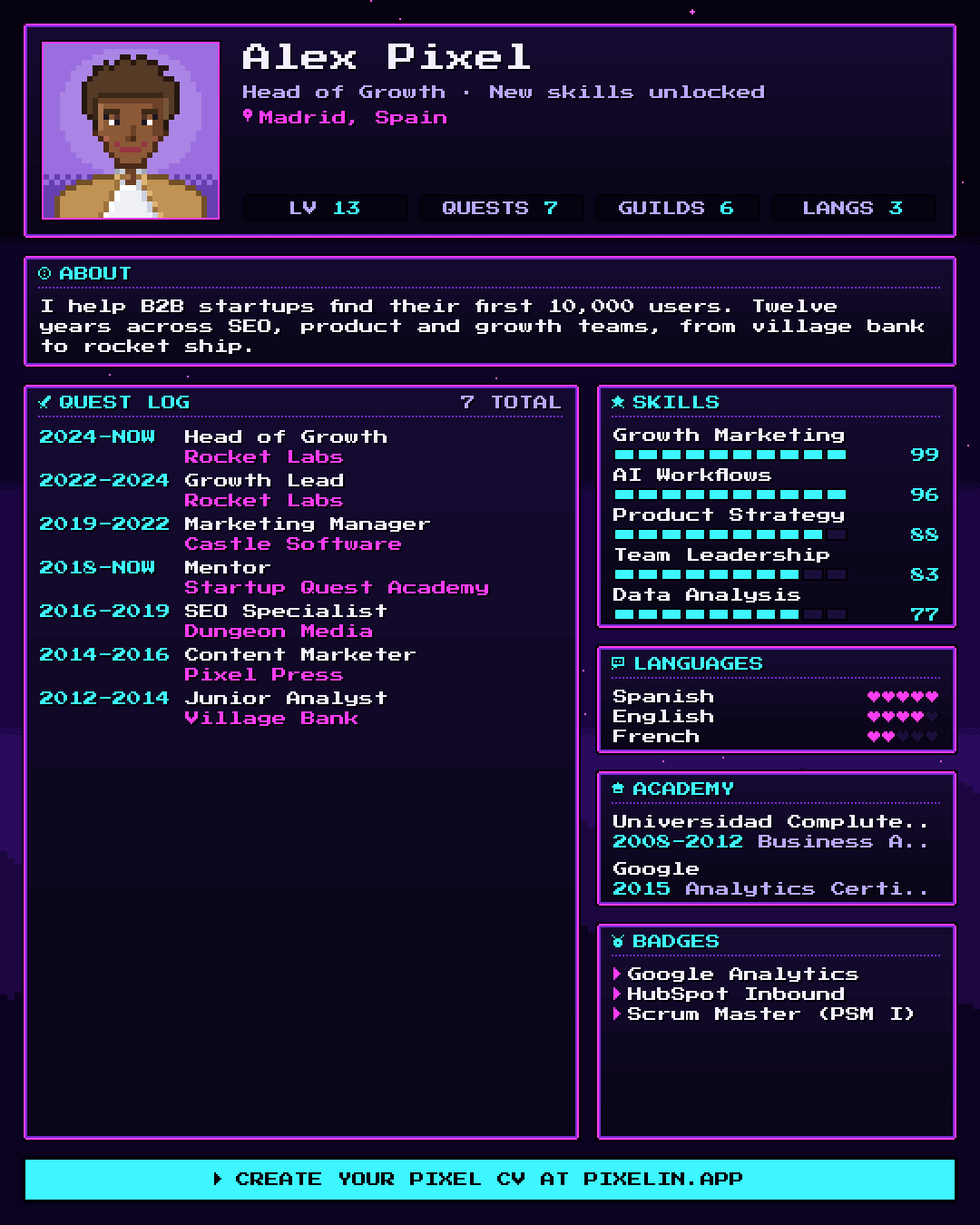
Drop your LinkedIn PDF into Pixelin to make yours.
All sources
The eight studies in the ranking
- Eloundou, Manning, Mishkin and Rock (OpenAI and University of Pennsylvania), GPTs are GPTs: An Early Look at the Labor Market Impact Potential of Large Language Models, March 2023, revised August 2023; published in Science, June 2024.
- Felten, Raj and Seamans, How will Language Modelers like ChatGPT Affect Occupations and Industries?, March 2023.
- Pew Research Center (Rakesh Kochhar), Which U.S. Workers Are More Exposed to AI on Their Jobs?, July 2023. Pew’s job lists are alphabetical examples, not rankings.
- International Labour Organization (Gmyrek et al.), Generative AI and Jobs: A Refined Global Index of Occupational Exposure, Working Paper 140, May 2025.
- Microsoft Research (Tomlinson, Jaffe, Wang, Counts and Suri), Working with AI: Measuring the Applicability of Generative AI to Occupations, July 2025, latest version October 2026. We use the latest version’s ranking, which differs slightly from the July 2025 list most news coverage quotes.
- Anthropic (Massenkoff and McCrory), Labor market impacts of AI: A new measure and early evidence, March 2026.
- World Economic Forum, Future of Jobs Report 2025, January 2025.
- US Bureau of Labor Statistics, Artificial intelligence, information technology, and employment, 2024–34, July 2026, and Industry and occupational employment projections overview and highlights, 2024–34, January 2026.
Context and real-world evidence
- International Labour Organization (Gmyrek, Berg and Bescond), Generative AI and jobs: A global analysis of potential effects on job quantity and quality, Working Paper 96, August 2023.
- International Labour Organization, Workers’ exposure to AI: What indicators tell us – and what they don’t, research brief, February 2026.
- International Monetary Fund (Cazzaniga et al.), Gen-AI: Artificial Intelligence and the Future of Work, Staff Discussion Note, January 2024.
- Goldman Sachs (Hatzius, Briggs, Kodnani and Pierdomenico), The Potentially Large Effects of Artificial Intelligence on Economic Growth, March 2023.
- Anthropic (Handa et al.), Which Economic Tasks are Performed with AI? Evidence from Millions of Claude Conversations, February 2025.
- Brynjolfsson, Chandar and Chen (Stanford Digital Economy Lab), Canaries in the Coal Mine? Six Facts about the Recent Employment Effects of Artificial Intelligence, August 2025, revised August 2026.
- Manning and Aguirre, How Adaptable Are American Workers to AI-Induced Job Displacement?, NBER, January 2026, with a Brookings summary.
- Humlum and Vestergaard, Large Language Models, Small Labor Market Effects, NBER, May 2025.
FAQ
Which jobs are most at risk from AI?
Across the studies we read, the jobs most often rated as highly exposed are customer service representatives, secretaries and administrative assistants, data entry clerks, telemarketers, credit and loan clerks, court reporters and transcriptionists, translators, writers, market researchers, financial analysts and programmers. Exposure means AI can do or speed up many of their tasks, not that the jobs will disappear.
What does "exposed to AI" mean?
It means a large share of a job's tasks could be done, or done much faster, with AI. Every study we cite stresses that this is not a prediction of job loss. Exposed jobs can shrink, change or even grow, depending on how employers use the time saved and on demand for the work.
Which jobs are least exposed to AI?
Hands-on jobs in construction, cleaning, food service, repair, firefighting and personal care. Cement masons, roofers, dishwashers, cleaners, orderlies and nursing assistants appear at the bottom of almost every list.
Has AI already caused job losses?
Not on a large scale so far. Studies from Anthropic, Stanford and Danish researchers find no broad rise in unemployment or fall in earnings for exposed workers. The clearest early sign is slower hiring of young workers, aged 22 to 25, into exposed jobs such as software development and customer service.
How did you build this ranking?
We took eight studies that name individual jobs, counted how many of them place each job among the most exposed or AI-affected, and kept the jobs that appear in at least three. Eight more studies, which work with broad job groups or measure real outcomes, are used for context.
What should I do if my job is on the list?
Learn to use AI for the tasks it handles well, and move your time and your resume toward the parts of the job it does not, such as judgment, relationships, responsibility and hands-on work. Keep your LinkedIn profile current so that, if you do change direction, your network sees your new skills.

Written by
On the internet since 1995 and launching online products since 2009, from one of the first app marketing agencies to tools like Pixelin. Writes about LinkedIn, resumes and standing out online.