
You find a job that fits, you spend an evening on the application, and then nothing. No reply, no rejection. A month later the same posting is still up, or it has been posted again. You may have met a ghost job: a listing with no real plan to hire behind it.
Ghost jobs have become one of the most talked-about frustrations of job hunting, and the coverage is full of big, confident numbers. Here is what the research actually shows, why companies do it, what the law now says, and how to spend your time on roles that are really open.
A note before we start: most surveys on ghost jobs are run by companies that sell job-search or hiring products, resume builders included, which is also our line of work. We say who ran each study and what it measured, so you can judge for yourself.
How common are ghost jobs?
The honest answer is that nobody knows exactly. The US Congressional Research Service, which writes briefings for Congress, says there are no official statistics on how many ghost jobs exist, and that the firms behind most of the estimates sell hiring-related services. What we do have are a few different kinds of evidence:
- Platform data. Greenhouse, an applicant tracking system used by thousands of companies, says that 18% to 22% of jobs posted on its platform in any given quarter are ghost jobs, meaning advertised with no intent to hire (December 2024). It has not published how it measures this.
- Employer surveys. In a Resume Builder survey of 649 US hiring managers (2024), 40% said their company had posted a fake listing in the past year, and 3 in 10 said one was live at the time. That is a share of managers who answered, not a share of all postings.
- Postings versus hires. Data company Revelio Labs found that US hires per job posting fell from 0.75 in 2018 to below 0.5 in 2023. An analysis of government data for MyPerfectResume found that in June 2025 about 30% of US job openings did not lead to a hire, against rarely more than 10% before 2020. Both are signs that more postings go unfilled, not proof that they were fake: hiring freezes, reposts and slow processes all show up the same way.
- What job seekers feel. In Greenhouse’s survey of 2,500 workers in the US, UK and Germany, 3 in 5 thought they had come across a ghost job. In a Resume Genius survey of 1,000 US job seekers in 2026, 67% suspected a fake or never-to-be-filled listing at least a few times.
Put together: ghost jobs are real and probably more common than a few years ago, but claims like “one in three jobs is fake” go well beyond what the data shows.
Why companies post jobs they do not fill
The reasons employers give, in surveys and in the Congressional Research Service’s review, fall into a few groups. Not all of them are cynical.
- Building a pipeline. Collecting resumes for a role that might open later, or for jobs with frequent turnover. Some “evergreen” postings stay up all year for this reason.
- Keeping up appearances. In the Resume Builder survey, the most common reasons managers gave were to look open to outside talent (67%), to look like the company is growing (66%), to make overworked employees think help is coming (63%) and to make employees feel replaceable (62%).
- The decision is already made. An internal candidate has been chosen, but the company posts the role anyway to show an open process.
- Plans changed. The budget was cut or the role was put on hold after it was posted, and nobody took the ad down.
- Forgotten or copied ads. A posting removed from the company’s site can live on for weeks on job boards that copied it.
Some listings are not ghost jobs but outright scams using a real company’s name to collect personal data or money. Never pay to apply, and be wary of anyone who asks for your bank details or ID before a formal offer.
What the law says
Until recently, posting a job you do not plan to fill was legal almost everywhere. That is starting to change:
- Ontario, Canada is the first place with a rule in force. Since January 1, 2026, employers with 25 or more employees must state in public job postings whether the role is an existing vacancy. They must also include a pay range, say if they use AI to screen applicants, and tell interviewed candidates within 45 days whether a decision has been made.
- New York passed a ghost job bill in both houses in 2026. It would require employers with 100 or more employees to say whether a role will be filled within 90 days, later, or is not a current vacancy, and to take filled postings down within two weeks. As of November 2026 it has not been signed by the Governor, so it is not law yet.
- Other US states, including New Jersey, California, Kentucky and Pennsylvania, have had similar bills introduced, but none has passed so far. There is no federal law on ghost jobs in the US.
Job boards are also under pressure. Indeed says it removes postings without a genuine intent to hire. LinkedIn shows a verification badge on some postings, but that confirms the company and the person posting, not that the job will be filled.
How to spot a ghost job
There is no test that proves a posting is fake. These signs, taken together, help you decide where to put your time. The first few come from the sources above; the rest are common sense from people who hire.
- It is old or keeps coming back. A posting that has been up for months, or is reposted every few weeks with the same text, is less likely to lead anywhere. Most job boards show when a job was posted.
- It is vague. A real opening usually has a specific team, clear responsibilities, real requirements and, more and more often, a pay range. A description that could fit any company is a weaker bet.
- It says so. Where rules like Ontario’s apply, read the line about whether the role is an existing vacancy.
- It is not on the company’s own site. If you cannot find the role on the employer’s careers page, it may have been filled or removed and copied elsewhere.
- The company is cutting, not growing. A recent hiring freeze or layoffs in the same team make a new opening less likely.
- Nobody can tell you about it. If a recruiter or someone on the team cannot say anything about the role, the timeline or the hiring manager, be careful.
Silence alone is not proof. Indeed points out that budgets, timelines and huge numbers of applicants also slow replies down, and many real processes take weeks.
How to spend your time on jobs that are real
- Apply early. A posting from the last few days is the most likely to be actively reviewed.
- Go direct. Apply on the company’s own careers page where you can, and check the role is listed there.
- Find a person. A short, polite message to the hiring manager or someone on the team often gets a straight answer about whether the role is open, and a referral if it is.
- Keep your applications quick. Ghost jobs hurt most when each application takes hours. A clean, up-to-date resume you can adapt in minutes changes that. If your LinkedIn profile is current, LinkedIn to Resume turns it into an ATS-friendly resume in about a minute, and our resume examples help with the lines that matter most.
- Do not wait. Keep applying until you have an offer in writing, however good an interview felt. Our guide on how to make your resume stand out can help with the next one.
- Let opportunities come to you. An active LinkedIn profile brings recruiters with real roles to you, which skips the ghost job problem entirely.
Be easy to find with a Pixel CV
That last point is where a Pixel CV helps. It turns your LinkedIn profile into a 16-bit character card, with your years of experience as your level, your skills as stat bars and your jobs in a Quest Log. Shared in a post saying you are open to new roles, it gets noticed by the people who are really hiring.
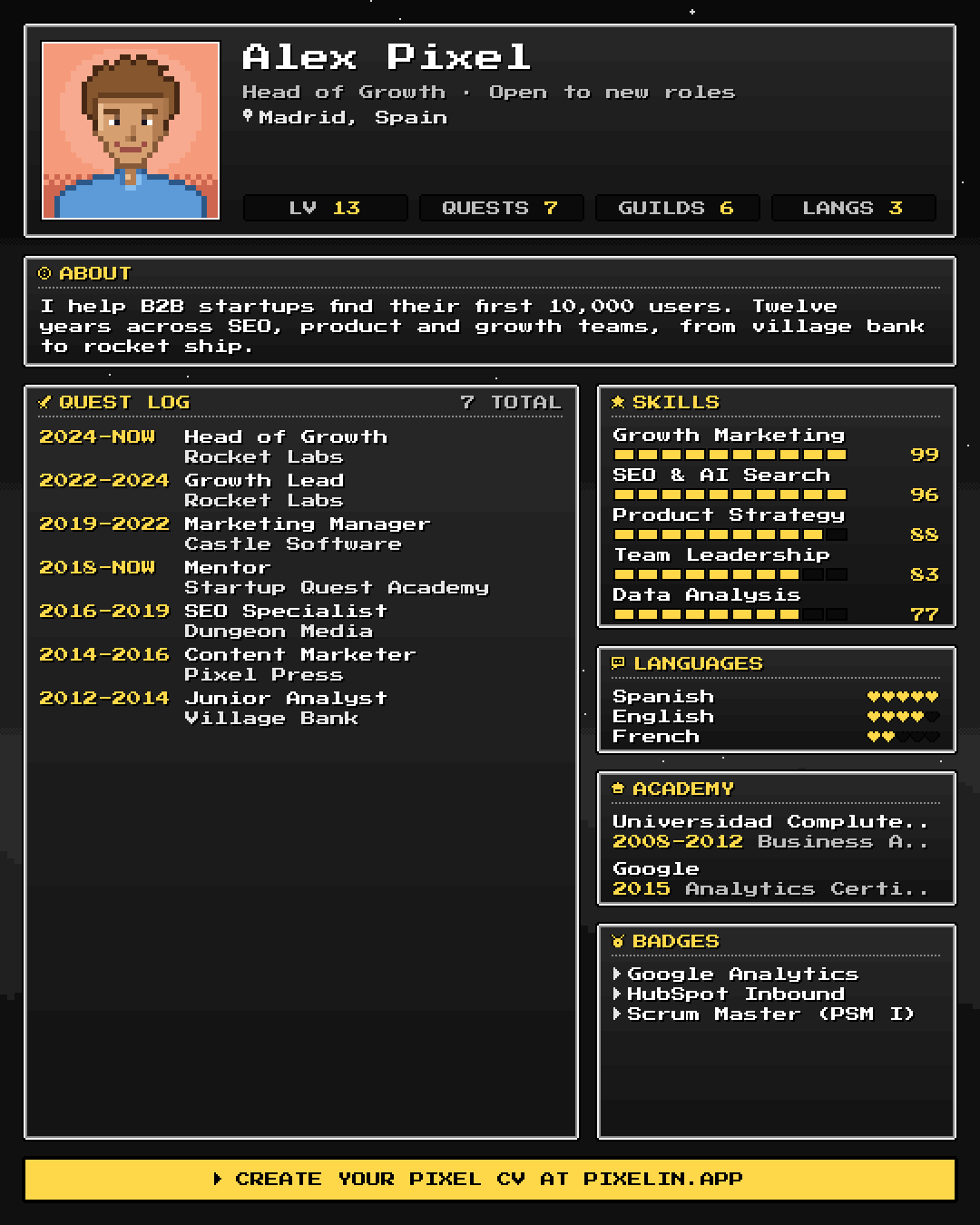
Save your LinkedIn profile as a PDF and drop it into Pixelin. It takes about a minute, and your PDF never leaves your browser.
FAQ
What is a ghost job?
A job posting that is not tied to a real plan to hire someone soon. It may be left up after the role was filled or cancelled, posted to collect resumes for later, or published for appearances, for example to look like the company is growing.
How common are ghost jobs?
Nobody knows exactly, and there are no official statistics. Greenhouse says 18% to 22% of the jobs posted on its platform each quarter are ghost jobs, and in a 2024 Resume Builder survey 40% of hiring managers said their company had posted a fake listing in the past year. Both come from companies in the hiring business and should be read with care.
Are ghost jobs illegal?
In most places, no. Ontario now requires employers with 25 or more employees to say in public postings whether the role is an existing vacancy. New York passed a bill in 2026 that would require similar disclosures, but it had not been signed into law as of November 2026, and there is no federal law in the US.
How can I tell if a job posting is real?
Check how old it is and whether it keeps being reposted, look for a specific description with a clear team, pay and requirements, see if the role also appears on the company's own careers page, and try to reach someone on the team. No single sign is proof, but several together are a good reason to spend your time elsewhere.
Is it worth applying to a job that might be a ghost job?
If it takes a few minutes, often yes, since many slow processes are real. Just do not let it replace applications to roles that show stronger signs of active hiring, and do not hold off on other options while you wait to hear back.

Written by
On the internet since 1995 and launching online products since 2009, from one of the first app marketing agencies to tools like Pixelin. Writes about LinkedIn, resumes and standing out online.